
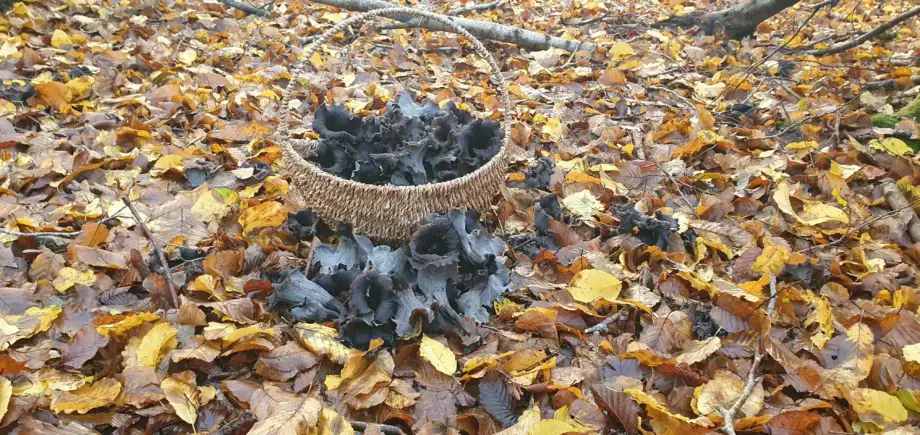
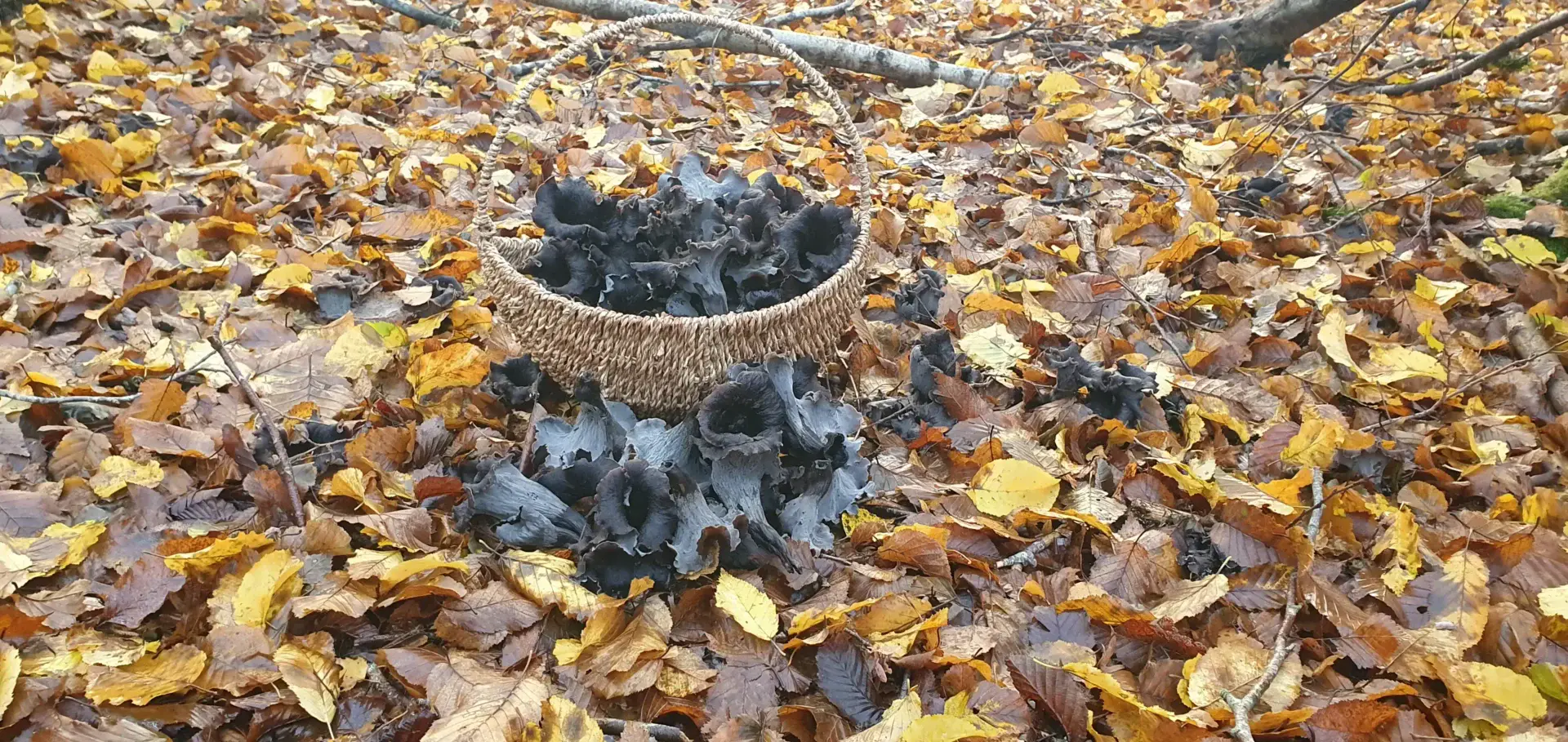
The Horn of Plenty, Craterellus cornucopioides, is one of the most charismatic and sought-after wild mushrooms in East Sussex woodlands. Sometimes called the Black Trumpet or Trumpet of Death, its dramatic appearance often leads beginners to overlook it but seasoned foragers know that this unassuming, dark funnel is one of the finest edible mushrooms on the forest floor. With an intense, smoky aroma and a rich, truffle-like depth, it’s a true gourmet ingredient.
Description & Identifying Features:
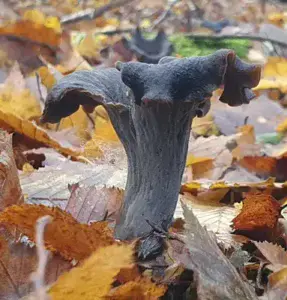
At first glance, Horn of Plenty can look like nothing more than a patch of dark leaf litter but once spotted, its form is unmistakable. The mushroom appears as a thin-walled, trumpet-shaped funnel that widens at the top and narrows to a hollow stem. Its exterior ranges from charcoal grey to black, sometimes with hints of brown, while the inner surface is smooth and velvety.
Unlike many mushrooms, it has no gills or pores; the spore surface is simply the smooth exterior. The edges of the funnel can be wavy or flared, giving it a delicate, almost floral appearance. Individual mushrooms vary in size from a few centimetres up to 10 cm tall, but they often grow in large, dense clusters, making them highly rewarding once you learn to spot them.
Habitat:
Horn of Plenty thrives in broadleaf woodlands, especially where beech, oak, or hazel dominate. It prefers mossy banks, leaf-litter pockets, and the edges of old pathways, often on sloping ground.
Despite their dark colour, they blend into the forest floor remarkably well. The best way to find them is to get your eye in, scan for clusters of dark funnels in damp, shaded areas. Once you find one, look carefully nearby; they often grow in generous patches.
Time of Year:
This species typically appears from late summer through late autumn, depending on rainfall. Its fruiting is closely tied to wet weather after a good soaking, the mushrooms can erupt in abundance. In milder years, they may persist well into November.
Safety & Edibility:
Horn of Plenty is edible, safe, and highly prized, both fresh and dried. Its flavour is rich, earthy, and almost smoky, concentrating beautifully when dehydrated. Dried Horn of Plenty can be ground into a powder that works wonderfully in sauces, pastas, stews, and risottos.
Unlike many dark mushrooms, there are no dangerous lookalikes in the UK that closely resemble it, making it a relatively safe find for beginners. As always, be absolutely sure of your identification before eating any wild mushroom.
Foraging Tips:
- Search damp, deciduous woodland floors, especially under beech and oak.
- Look on banks, slopes, or old pathway edges — they love disturbed ground.
- Once you find one, pause and scan the area; they grow abundantly in clusters.
- Harvest gently to avoid tearing the thin, fragile walls of the funnel.
- Clean carefully — their dark colour hides grit and small leaves.
- Drying enhances their flavour immensely; they store for years when dehydrated.
- Always forage responsibly, leaving some behind to continue the life cycle.
Conclusion:
Finding Horn of Plenty is a moment of pure foraging joy. Despite their sombre appearance, these mushrooms are a culinary treasure, transforming simple dishes with their deep, aromatic flavour. Train your eye to spot their dark, funnelled shapes among the autumn leaves, and you may discover one of the woodland’s most rewarding gourmet fungi.